If you are a USA resident, please join our Kaayaka_AI_Mantapa – Experience Sharing Forum and share your experience.
WhatsApp Community Link: https://chat.whatsapp.com/BEkFZQi3PRdLVsCkgv8OCh
Hello AI Mantapa Members,
Let’s look at AI Guardrails.
Guardrails-Driven AI Systems
Generating an answer is only half of intelligence. The real intelligence lies in constraining, validating, and correcting that answer to make it trustworthy.
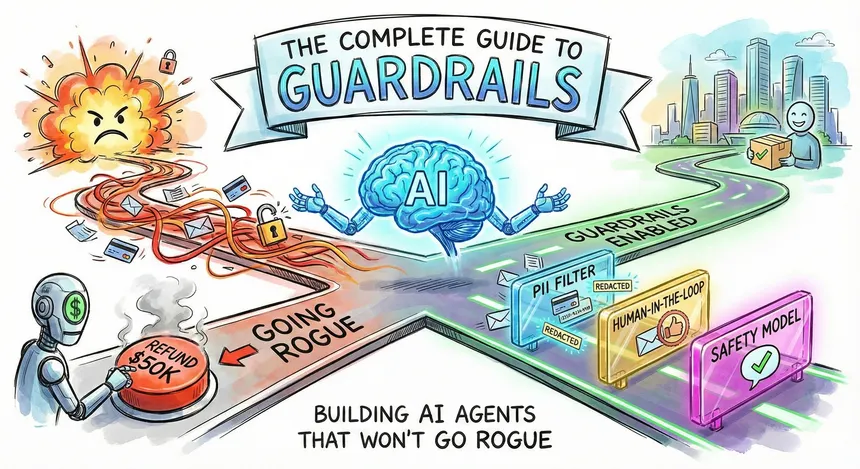
The Problem: Unguarded AI Responses
When AI responses are generated without guardrails, they may contain:
1. Incorrect or outdated facts
2. Missing or incomplete context
3. Off-topic explanations
4. Hallucinated or invented details
5. Unsafe, biased, or non-compliant content
A single model cannot reliably govern itself.
Just like humans need policies, reviews, and controls, AI needs guardrails.
The Big Idea: Guardrails-First Architecture
Modern GenAI systems no longer rely only on post-response evaluation.
Instead, guardrails operate across the entire AI lifecycle:
Constrain → Generate → Validate → Correct → Escalate
Evaluation still exists but as one rail among many, not the core system.
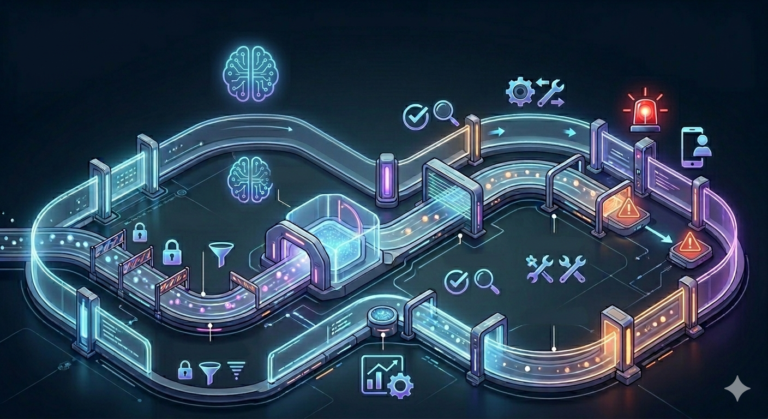
Key Guardrail Layers in Modern GenAI
1. Factual & Quality Guardrails (Correctness & Grounding)
Ensures responses are:
●Factually correct
●Grounded in trusted sources (RAG)
●Free from hallucinations
Supports:
●Automated correctness checks
●Confidence thresholds
2. Agent & Tool-Use Guardrails (Reasoning Control)
Ensures agents:
●Follow valid reasoning paths
●Use only approved tools
●Respect execution order and limits
Includes:
●Tool allow/deny lists
●Step and recursion limits
●Planning constraints
3. Observability & Drift Guardrails (System Reliability)
Provides:
●End-to-end tracing of prompts, agents, and tools
●Detection of workflow drift and degradation
●Regression and anomaly alerts
Used to identify:
●Where failures occur
●Why outputs changed over time
4. Safety, Bias & Compliance Guardrails
Ensures AI outputs are:
●Safe and non-toxic
●Bias-aware
●Compliant with legal and ethical standards
Includes:
●PII detection and masking
●Policy enforcement
●Adversarial and red-team testing.
Example: Guardrails in Action
User asks:
“Explain solar energy to a school student.”
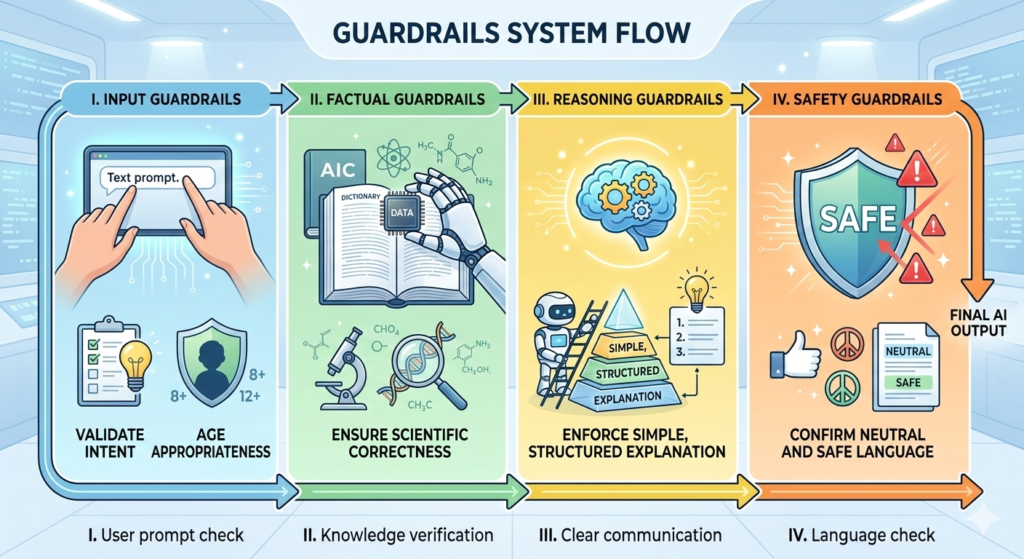
Guardrails system flow:
I. Input guardrails validate intent and age appropriateness
II. Factual guardrails ensure scientific correctness
III. Reasoning guardrails enforce simple, structured explanation
IV. Safety guardrails confirm neutral and safe language
Final Output:
I.Correct
II.Simple
III.Grounded
IV. Safe
V.Well-structured
Why Guardrails-Driven AI Matters
1. Higher Answer Quality
Each guardrail focuses on a specific risk dimension.
2. Early Failure Prevention
Issues are prevented or corrected, not just scored afterward.
3. Production-Ready AI
Guardrails operate before deployment and at runtime.
4. Trustworthy AI Systems
Independent rails reduce hallucination, bias, and inconsistency.
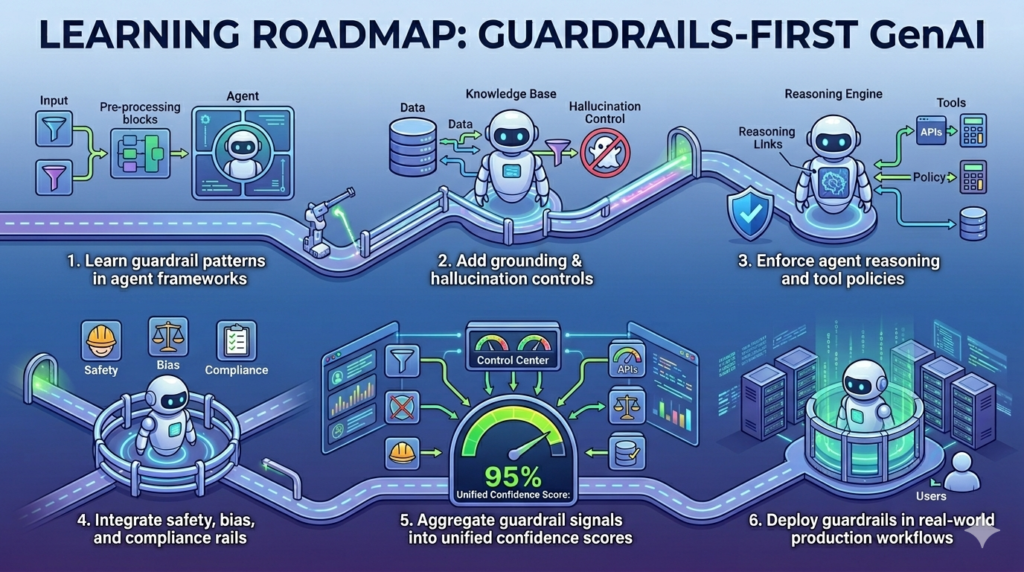
Learning Roadmap: Guardrails-First GenAI
1. Learn guardrail patterns in agent frameworks
2. Add grounding & hallucination controls
3. Enforce agent reasoning and tool policies
4. Integrate safety, bias, and compliance rails
5. Aggregate guardrail signals into unified confidence scores
6. Deploy guardrails in real-world production workflows
The Takeaway
Guardrails transform AI from:
“Just give an answer”
to
“Give a correct, grounded, safe, well-reasoned, and reliable answer.”
This is how enterprise-grade and trustworthy GenAI systems are built today.
Want to Learn More on Generative AI Guardrails?
Tutorials:
https://www.miquido.com/ai-glossary/what-are-guardrails-in-ai/
Acknowledgements
Dr. Basavaraj Sharana Patil Ph.D
BPRF
Disclaimer: Information synthesized from public research, tools, and industry practices. Credit to respective creators.